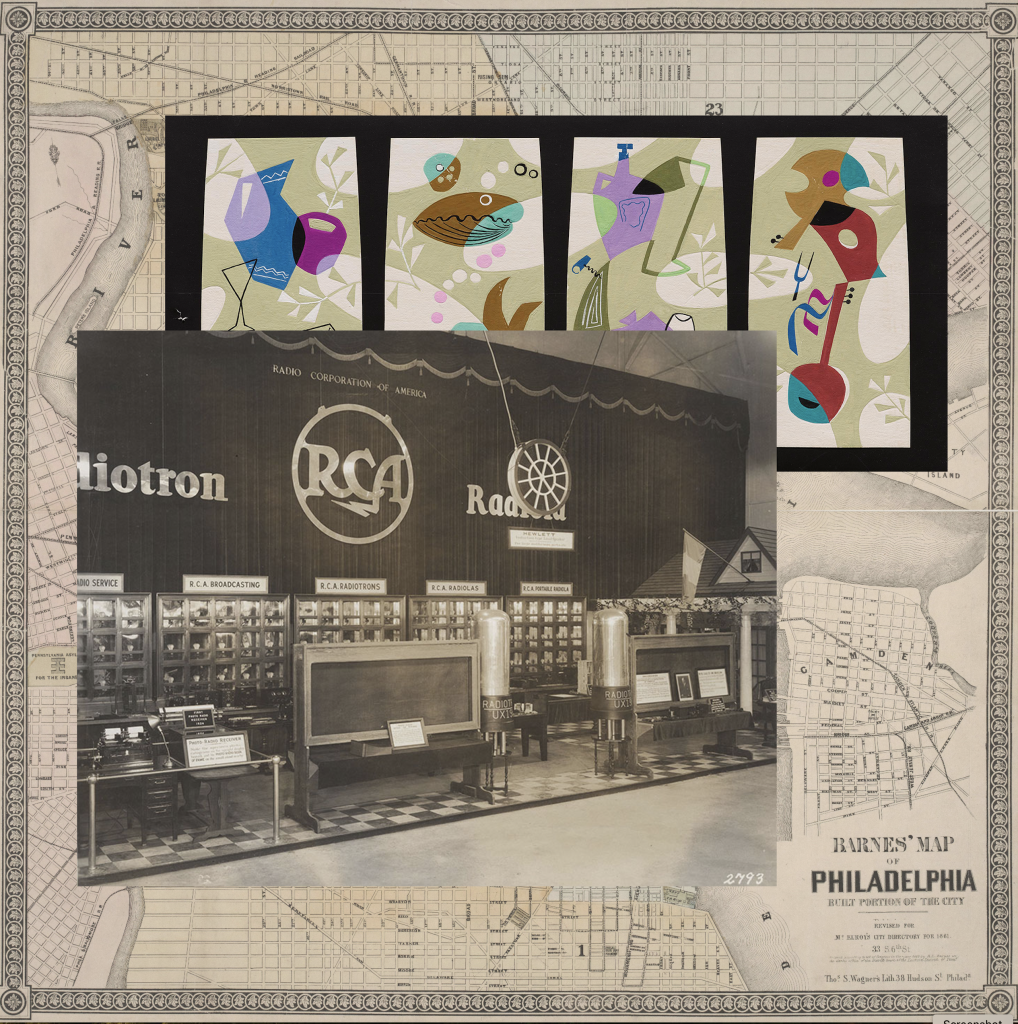
Ideally, around this point in the semester, I’d ask you to propose a topic for your final project, our collaborative Local Media Field Guide. Developing a proposal now would allow you to focus your independent research for the following weeks — and it would give me an opportunity to offer feedback on your writing. But I’d much rather have you continue to explore, to introduce yourself to lots more media formats, before settling on a topic! Expand your mind for a few more weeks before focusing 🙂
This week we’ll start by looking ahead to the creation of our collective Local Media Field Guide. We’ll consider format and discuss your preliminary topic ideas. Then, we’ll consider how radio’s specific affordances shape its function as a local medium. How is radio like and unlike television? What roles did, and does it still, play in sharing local news and facilitating local participation in the creation and distribution of local information and culture? How might local radio serve as one component of a broader local music media ecology — along with performance venues, record stores, arts journalists, music-focused graphic designers, etc. — and a shaper of local music “scenes”?
1:45 – 2:45: Design Workshop in our Regular Van Pelt Classroom
Our field guide designer, Elaine Lopez, will join us to discuss possible formats for our final project, which could in turn inform your choice of subject!
2:45 – 3:15: Reading Discussion in Van Pelt
3:30 – 4:45: WQHS Class Visit / Field Trip
Giselle Wagner, Station Manager, WQHS, will join us for a discussion in our classroom, and then, for the last half hour of class, we’ll take a tour of the station at the Hollenback Center, 3000 South Street
Reading Response: Shannon, Gerardo — please post to our Reading Response Slide Deck by noon
.
To Read / Watch for Today:
- Read Jill Lepore, “The Last Time Democracy Almost Died,” The New Yorker (January 27, 2020); focus on the sections about radio — and think about how 📻 and public libraries can work together as part of a civic media ecosystem 🙂 [~30min]
- Read Christina Dunbar Hester, “‘Producing ‘Participation’? The Pleasures and Perils of Technical Engagement in Radio Activism,” Public Culture 26:1 (2013): 25-50 [focus on 25-39; ~40min]. Note: what DH calls Pandora is actually the Philly-based Prometheus Radio Project.
- Watch Palladium, “London Pirate Radio” (2011) [video: 16:19] – and this piece documenting a few stations still broadcasting in 2022 [video: 4:21].
- Optional: Read Larisa Kingston Moon, “Race, Class, and Sonic Autonomy in the Tower Blocks: Pirate Radio’s Exilic Possibilities,” International Journal of Communication 17 (2023) [~50min].
- Explore some local college and community stations in our “Philly Radio” Arena channel.
- Read Delaney Parks, “The Radio Rebels of Penn,” 34th Street (March 24, 2023) [~10min].
Supplemental Resources:
- Roger Bova, QSL? Do You Confirm Receipt of My Transmission? (Standards Manual, 2022).
- Tom Cordell, “Mutualism, Massive and the City to Come: Jungle Pirate Radio in 1990s London,” Soundings: A Journal of Politics and Culture 77 (Spring 2021).
- Peter Crimmins, “New Community Radio Station Sounds in Philadelphia,” WHYY (October 20, 2016).
- Vibiana Bowman Cvetkovic, “Public Media,” The Encyclopedia of Greater Philadelphia (2016).
- Jesse Drew, “Urban Pirates to Rural Radio: Low Power FM in the US Heartland” (May 16, 2020) [video: 1:36:41].
- Christina Dunbar-Hester, Low Power to the People: Pirates, Protest, and Politics in FM Radio Activism (MIT Press, 2014).
- Christina Dunber-Hester, “Not Entirely Analog(ous): Low-Power FM Radio as Community, Relations, and Knowledge in Context,” Radio Journal: International Studies in Broadcast & Audio Media 18:1 (2020).
- Christina Dunbar-Hester, “Spectral Utopias: Community Radio in the United States from 1970-Present,” Historia Actual Online 54 (Winter 2021).
- Christina Dunbar-Hester, “What’s Local? Localism as a Discursive Boundary Object in Low-Power Radio Policymaking,” Communication, Culture and Critique 6:4 (2013).
- Steve Goodman, “Contagious Transmission” in Sonic Warfare: Sound, Affect, and the Ecology of Fear (MIT Press, 2010): 177-82.
- Rick Karr, “Prometheus Unbound,” The Nation (May 5, 2005).
- *Larisa Mann, “Pirate Radio: Nonlinear Innovation for Autonomous Culture,” Radical Networks (March 15, 2019) [video: 32:41].
- Larisa Mann, “Pirate Radio and Public Housing,” Fordham University (April 22, 2016) [video: 1:05:03].
- Radio Survivor Podcast.
- Josh Shepperd, Shadow of the New Deal: The Victory of Public Broadcasting (University of Illinois Press, 2023).
Citizens Band
- Art M. Blake, “Audible Citizenship and Audiomobility: Race, Technology, and CB Radio,” American Quarterly 63:3 (2011).
- Cheryl Higashida, “Citizens Band: Surveillance, Dark Sousveillance, and Social Movements,” American Quarterly 74:2 (2022).
- Rory Solomon, “Citizens Band” in Meshiness: Mesh Networks and the Politics of Connectivity, Dissertation, New York University (2000).
Emergency Media
- Hamilton Bean, Mobile Technology and the Transformation of Public Alert and Warning (Bloomsbury, 2019).
- Elizabeth Ellcessor, excerpt of Introduction: “Mediating Emergency, Maintaining Normalcy” in In Case of Emergency: How Technologies Mediate Crisis and Normalize Inequality (NYU Press, 2022): 1-18 [stop at “Researching Emergency”].
- Elizabeth Ellcessor, “Technologies, Bureaucracy and Disaster,” New Media & Society 22:9 (2020).
- Megan Finn, Documenting Aftermath: Information Infrastructures in the Wake of Disaster (MIT Press, 2018).
- Eric Klinenberg, Fighting for Air: The Battle to Control America’s Media (Metropolitan Books, 2007); “911 Calls in North Dakota Town Reveal Dangers of Media Consolidation,” Democracy Now (January 25, 2007).
- Florian Meissner and Jun Tsukada, “Local Media and Disaster Reporting in Japan” in Agnes Gulyas and David Baines, eds., The Routledge Companion to Local Media and Journalism (Routledge, 2020).
- Cait McKinney, “Calling to Talk and Listening Well” in Information Activism: A Queer History of Lesbian Media Technologies (Duke University Press, 2020): 67-104.
Music Scenes
- There’s quite a bit of academic research on music and geography, or music scenes.
- Kiersten Adams, “Preparing the Archives: Sun Ra Comes to Kislak Center,” The Philadelphia Tribune (January 8, 2024).
- Jamal Collins’s research on soundscapes and music venues
- Jerome Hodos and David Grazian, “The Philadelphia Sound” ASA Footnotes (July/August 2005): 1, 7.
- Earl Hopkins, “Meet the Sound Engineer Creating Philly’s New Sound,” The Philadelphia Inquirer (January 7, 2024).
- Robin James, The Future of Rock and Roll: 97X WOXY and the Fight for True Independence (University of North Carolina Press, 2023).
- * Katherine Rye Jewell, Live from the Underground: A History of College Radio (UNC Press, 2023).
- Kislak Center, Philadelphia Jazz Project, Ars Nova Workshop, Philly CAM, and Philadelphia Jazz Musicians, “Philadelphia Jazz Oral History Project,” Sachs Program for Arts Innovation (2022).
- Maria Sherman, “How Philadelphia Became an Epicenter for Rock Music in the U.S.,” Alternative Press (March 23, 2023).
- Lowry Yankwich, “Capturing the Philadelphia Sound with Samori Coles,” Broad Street Review (December 13, 2023).